A Winter Field Walk for Noticing Crop Stubble
A winter field walk for noticing crop stubble helps you compare stem height, direction, and distribution from a path without damaging the field.
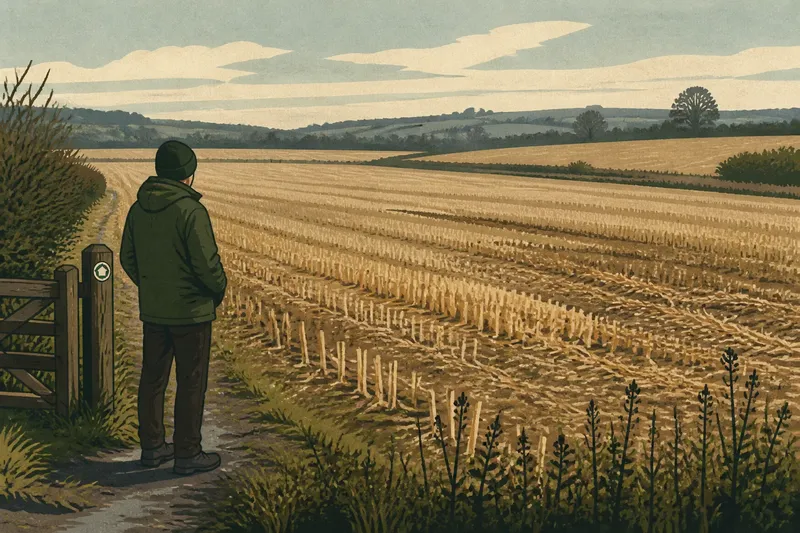
Where should you look on a winter field walk, and what can crop stubble tell you without turning a few stalks into a confident farming story? A winter field walk for noticing crop stubble starts with a view from a permitted path, not a boot in the crop. Compare what is visible across the field: the cut stems, loose straw, and patches where the ground shows through.
Choose a route that leaves the crop alone
Use a public footpath, bridleway, or other route open to you, and follow signs and temporary closures. A field can look empty while machinery, livestock, wet ground, or farm work is still present. Keep dogs under control where required, and leave gates as you find them.
Look for a bend, rise, or gap in a hedge that gives you a broad view without blocking the route. A closer look is not worth trampling the farmer’s next task.
Give the walk one modest aim: compare the visible stubble in different parts of the same field.
Read the field from the broad view to the ground
First take in the whole field. Does the surface look even, fall into bands, or break into patches? Note where its color or texture changes and whether the change follows a slope, track, or headland.
Then inspect the ground you can see from the path. Are cut stems fairly even, or are some areas thinner? Is loose straw mixed among them? Does the stubble rise above bare-looking soil, or do weeds and other plants partly cover it? These details describe the present surface; they do not explain how it came to look that way.
Alternate between the distant view and a visible detail. This helps show whether a feature continues across the field or belongs to one small patch.
Compare the height of the cut stems
Some fields appear to have a fairly even cut; others show taller stalks beside shorter ones. Describe the contrast and where it occurs. “Taller along the far edge” records what is visible. “Left for wildlife” assigns an intention you may not know.
Crop type, harvesting method, ground conditions, machinery, and uneven terrain can all affect apparent height. A distant view can disguise changes in the ground, too, so a clear-looking contrast may still have several explanations.
Say you see short stubble near a gateway and taller stems farther into the field. Note those locations and whether the change follows a visible track. The pattern is worth recording, but it does not tell you whether machinery, a deliberate choice, or the ground produced it.
Follow the direction and shape of the remaining stems
Stubble may lean or lie in a common direction. Look for repeated lines, curved bands, or places where the apparent direction changes. A line can make the field’s surface easier to read, but wind, terrain, and events after cutting may also affect what you see.
Check whether a line continues toward a headland, turns near an edge, or fades where the surface is harder to see. Low winter light can sharpen small ridges and shadows. If the pattern seems different as you walk along the path, note that change in viewing angle.
Describe the visible line; do not treat it as a complete map of the harvest.
Find where the stubble becomes patchy
Look for gaps, clumps, strips, and transitions between cut stems and other ground cover. Is the patchiness limited to one part of the field or repeated elsewhere? Does it sit beside a visible feature, such as a gateway, hedge, or slope?
Variation can reflect the way a crop was cut or collected, ground that was wet or rough, weeds, lodged crop, or leftover plant material. From a path, these causes may look similar. “A narrow patch with more straw near the lower edge” keeps the shape and position; “a missed strip” supplies a cause you cannot confirm.
Use field edges to locate a visible change
Compare the stubble near a hedge, ditch, or gate with what you can see farther into the field. Does the apparent cut height change near the edge? Is the ground more overgrown, shaded, or difficult to see there?
An edge can affect light, access, and visibility, but it does not explain every difference nearby. A dense margin may conceal ground; a gateway may simply offer a better view. Use the edge as a reference point, not a verdict. If woodland or water lies beside the field, note it only when it helps explain why the surface is harder to see.
What can a winter field walk establish?
Can stubble identify the crop?
Appearance alone may not identify a crop reliably, especially from a distance or after weather and new growth have changed the surface. Treat an identification as tentative unless you have other clear information.
Can cut stems show how harvesting was done?
They can show visible lines, differences in height, and changes in distribution. Those patterns can have several causes, so describe what you see rather than naming a definite operation.
Does uneven stubble mean the harvest went wrong?
Unevenness by itself does not establish that. Crop, ground, machinery, weather, and later changes can all affect what remains visible.
Should you enter the field for a closer look?
No. Stay on a route open to you and use the view available from there. A close-up is not worth damaging a crop or disturbing farm work.
Make a field note that helps with the next walk
A small notebook is enough. Record the route or viewpoint and describe one feature in plain language. These checks turn a vague impression into a useful note:
- Check whether stems look even in height across the visible area; if they do, note that consistency, but if they do not, record where the taller and shorter patches occur.
- Check whether a line of leaning stems continues toward a visible headland; if it does, note its direction, but if it fades, record where the line becomes unclear.
- Check whether loose straw gathers in a distinct patch; if it does, describe its shape and position, but if it blends into the stubble, note that there is no clear boundary.
- Check whether bare-looking soil appears between stems; if it does, record where it shows, but if plant cover obscures the ground, mark the surface as difficult to assess.
- Check whether the pattern changes beside a hedge, ditch, or gateway; if it does, note the nearby feature, but if the change is not clear, leave the edge out of the description.
- Check whether a visible pattern persists from a second permitted viewpoint; if it does, record that it can be seen from both, but if it disappears, note the viewing angle rather than assuming the feature has changed.
Imagine you are on a public path beside a field with short-looking stubble near a gateway and a pale band of loose straw farther across. From the path, you note that the band runs toward the far hedge, while the stems inside it do not appear taller than those around it. You write down the gateway, the band’s direction, and the limit of your view; you do not call it a missed strip or infer why the straw lies there. On your next permitted walk, you see that the band is still visible from the same stretch of path. Your resulting note is that the band persists from that viewpoint, while its cause remains unknown.
A winter field walk for noticing crop stubble is most useful when it gives you a clearer description of the field’s surface, not a story about decisions you could not see. Keep the route, viewpoint, and visible pattern together in your notes; that makes a later comparison far more useful than a confident guess.