The Coppice and the Making of a Working Wood
Coppice woodland management becomes easier to understand when you can distinguish a cut stool, a stand of mature trees, and a wood combining both.
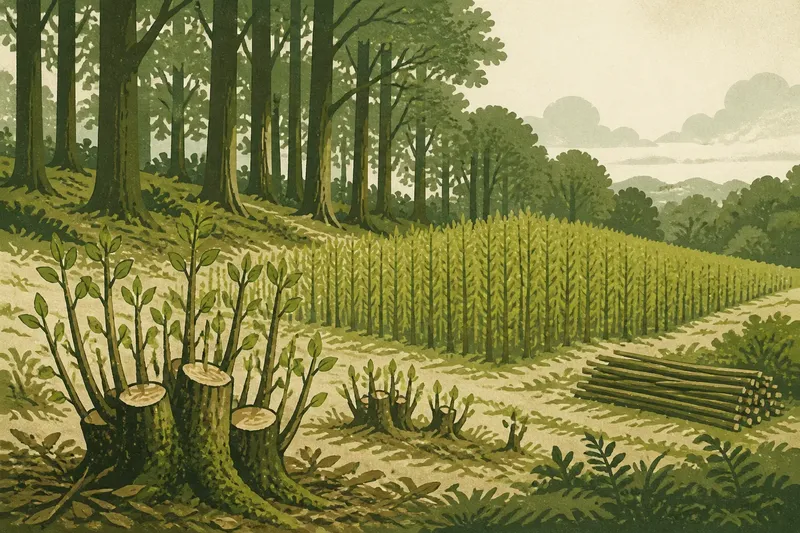
Why does one patch of woodland look freshly cut while the next holds tall, crowded stems? Coppice woodland management explains that contrast: trees are cut near their base, then allowed to regrow from the rooted stool. The result is not simply a patchwork of ages but a way of organizing work, materials, and the shape of the wood.
The useful comparison is between coppice, high forest, and woods that combine the two. These terms describe different structures and intentions; they do not always label an entire wood neatly. A patch can be legible as a woodland form without revealing exactly why its present shape was chosen.
Coppice divides a wood into working patches
In coppicing, trees are cut near the ground and new shoots grow from the remaining stool. Hazel, willow, ash, and sweet chestnut are associated with coppice, though species and local conditions affect how a particular stand responds. The stems can be cut again after regrowth, beginning another cycle.
Rather than cutting every tree at once, a working coppice is commonly divided into sections at different stages. One patch may have young shoots, another taller poles, and another mature stems awaiting a future cut. The arrangement spreads work through the wood and gives each patch a different structure.
Cutting also changes the ground beneath the trees. A recently opened patch admits more light; as shoots rise, shade returns. Grasses, flowers, brambles, and young trees respond to those shifts, with the result depending on the species and surrounding landscape. Coppice is therefore a sequence of changing conditions, not a single fixed appearance.
A cleared patch can look severe if viewed as a stand-alone scene. In a managed coppice, it may be one phase in a planned sequence. But cutting alone does not establish that a wood is being managed well; the pattern needs to make sense for the site and its purpose.
High forest retains a taller structure
High forest is generally managed to retain trees growing to larger size, with a canopy kept for longer than in a short coppice cycle. Its trees may be similar in age or mixed in age, depending on the wood’s history and management. Larger timber, shade, shelter, or continuity of canopy may matter more than recurring small-diameter material.
The distinction is not simply cut versus uncut. High forest can involve selective felling, while coppice can include standards: individual trees left to grow above the regularly cut understorey. In coppice-with-standards, the lower layer regrows after cutting while selected oaks or other trees remain overhead.
Look at the structure rather than guessing from tree height alone. A stand of tall stems could be managed high forest, coppice that has not been cut for some time, or a mixture developed over generations.
Mixed woods combine different purposes
Some woods include actively managed coppice in one area and mature trees in another. A section cut in the past may now carry dense, tall stems, while elsewhere mature trees stand above regrowth. Such patterns can reflect deliberate choices, changes in ownership or demand, or an interrupted routine.
A mixed structure can suit ground that varies in slope, wetness, tree species, or access. It can also accommodate several aims, such as retaining mature trees while renewing selected patches. There is no need for every part of a wood to follow one system.
Still, “mixed” should describe an actual arrangement, not serve as a polite name for uncertainty. Dense growth across a former coppice area may be an acceptable outcome, but it differs from a planned combination of structures. Begin by identifying what the wood is meant to provide.
Match the woodland form to its purpose
Choosing between coppice, high forest, or a mixture depends on the trees, ground, available work, and intended use. Check each factor and let the result shape the decision:
- Check for suitable regrowth species and a use for poles. If both are present, coppice may fit; if either is absent, consider retaining a taller structure or getting site-specific advice.
- Check whether mature trees and a lasting canopy are priorities. If they are, favor high forest or retain standards; if not, assess whether selected patches can serve another purpose.
- Check whether different parts of the wood have distinct conditions. If slope, wet ground, or access varies, consider different structures by patch; if conditions are similar, compare the options across the whole area.
- Check for stools, repeated cut surfaces, and old patch boundaries. If these recur in a pattern, use them as clues to past coppicing; if they do not, avoid assigning a history from one feature alone.
- Check whether regular work and a use for the resulting material are realistic. If both are available, a recurring cycle may be practical; if either is missing, consider a less work-dependent plan.
- Check for conservation designations or local rules before work begins. If any may apply, consult a qualified forester or woodland adviser and the relevant authority; if none are known, confirm that status rather than assuming it.
Say an owner inherits a wood with hazel stools in one section, mature oak in another, and no current use for cut poles. The owner checks the stools and finds several share old cut bases, then confirms the oak patch is valued for its canopy. Since there is no outlet for poles and no plan for regular work, the owner decides not to treat the entire wood as active coppice; a mixed structure that retains the oaks and leaves the hazel section undisturbed for now is the more workable choice. The observable result is a wood with distinct areas, not a uniform cut or a claim that the hazel is already part of a maintained cycle.
Actual woodland work depends on species, site conditions, conservation interests, and local rules. A qualified forester or woodland adviser can assess those particulars; visible patterns provide context, not a substitute for professional guidance.
What do common coppice patterns mean?
How can you tell coppice from scrub?
Coppice often has several stems rising from an older shared stool, while scrub is a broad term for dense, usually low woody growth. Regrowth from an abandoned coppice can look like scrub, so look for repeated stools and a patch pattern rather than relying on one plant.
Does coppicing mean cutting every tree at once?
No. A coppice wood is often divided into sections at different stages, so cutting one patch does not require cutting the rest. Treating every section alike would remove that staggered structure.
Can a wood contain coppice and high forest?
Yes. Coppice-with-standards combines regrowing stools beneath trees retained to grow taller, and separate patches can follow different systems. The terms describe structures and intentions, not necessarily exclusive labels for a whole property.
What happens when coppice is no longer cut?
Stems can grow taller and denser, while the open-ground phase becomes less frequent or disappears. That changes the wood’s structure; whether it matters depends on the owner’s purpose and the site’s ecological context.
Read the wood through its structure and history
Instead of treating each visit as a search for clues, compare how the wood is arranged. Note where young regrowth gives way to tall stems, whether older trees stand within or beside those patches, and how the pattern follows rides, streams, slopes, or field edges. A compartment may be irregular because the ground and access shaped it; woods rarely arrange themselves for the convenience of a diagram.
Season changes what is easy to see. Bare branches can make stools and patch edges clearer, while leafy growth reveals the ground layer and the amount of light beneath the canopy. Neither view tells the whole story, but together they help distinguish a recent opening from a permanent gap or an old coppice area that has grown dense.
The phrase coppice woodland management is most useful when it points to a continuing relationship between trees, labor, materials, and the conditions beneath the canopy. A working wood is not defined by looking tidy or freshly cut; its structure needs to serve a purpose that can be maintained. Before naming the whole stand, identify one clear boundary between growth types and ask what practical role each side could have.