Stream, Ditch or Drain: How to Tell What a Watercourse Is
Stream, ditch or drain: identify visible channel clues, distinguish likely forms, and write a useful description without mistaking appearance for purpose.
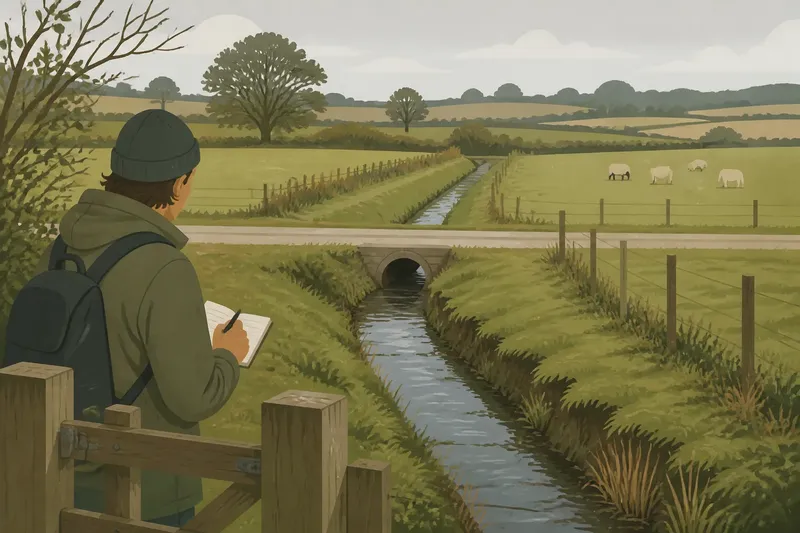
Is that narrow line of water a stream, ditch or drain? To tell a stream, ditch or drain apart, look at how the channel is built into the land, where it continues, and whether you can see a pipe or culvert. A glance from a gate may suggest a name; it cannot reveal every hidden connection.
There is no need to turn this into a week-long assignment. Make one safe visit when convenient, then compare the view after weather changes only if access remains safe. The aim is a useful description, not a verdict about ownership, water source or function.
Start with the channel’s physical form
A stream is an open watercourse that may have bends, varied banks, shallow margins or exposed stones and roots. A ditch often has a visibly cut or maintained profile, sometimes running beside a field or road. A drain may be enclosed in a pipe or covered channel, with an inlet or outlet visible at either end.
Those forms overlap. A stream can be straightened, a ditch can gather plants and sediment, and an open ditch may connect to a buried drain. Describe what you can see before choosing a label.
From a safe path or a place where you have permission, note whether the channel is straight or winding, whether its sides look cut or irregular, and whether water is visible. A phone photo from the same viewpoint can help compare later visits. Do not estimate depth from a distant view or approach soft, steep or flooded banks.
Use the channel’s setting to narrow the possibilities
Notice whether the watercourse runs along a field edge, follows the foot of a slope, passes beneath a road, joins another channel or disappears under a grate. These relationships can help you describe its course. They do not establish where water originates or what a hidden section connects to.
Look for visible signs of construction or upkeep: a culvert, a regular cut edge, a grate, cleared vegetation or a pipe outlet. Each is a clue, not proof of purpose. A maintained stream can have engineered banks; an old ditch can look like an unmanaged channel.
Say you see a straight channel beside pasture, a pipe beneath a track and standing water nearby. Write those three observations separately. You might describe an open channel with a covered crossing, while leaving its source and the pipe’s connection unknown.
Compare the likely forms without forcing a label
- Check for a varied, winding open channel; if present, describe it as stream-like, but use “open channel” if other clues conflict.
- Check for a straight or regularly cut channel beside worked land; if present, call it ditch-like, but avoid naming its purpose without more information.
- Check for a visible pipe, grate or covered section; if present, note a drain or culvert feature, but do not infer the hidden route.
- Check whether the bed is visible and appears stony, sandy, muddy or obscured; if visible, record the material, but do not treat it as proof of origin.
- Check whether water is present or the surface appears to move; if so, describe that condition, but do not claim the channel flows year-round.
- Check for cut vegetation or a cleared edge; if present, note signs of upkeep, but leave who maintained it and why unresolved.
If the clues disagree, a neutral description is more useful than a confident guess. “Narrow open channel with a squared bank and a culvert crossing” says what is there without pretending the name settles its history.
Weather changes the view, not the channel’s identity
After rain, water may become more visible, the surface may look disturbed, or leaves and sediment may collect. During a dry spell, the bed may show through or the channel may appear dry. Record the condition and the weather in plain terms; a visit captures a moment, not a seasonal pattern.
Do not visit during a flood warning or when banks are saturated and unstable. If conditions are unsafe, skip the observation. No useful field note requires standing beside fast, discolored water.
Which clues answer the questions readers ask?
Can a straight channel still be a stream?
Yes. A stream may have been straightened or constrained by nearby land use. Straightness describes its present form, not its origin.
Does water in a ditch mean it flows all year?
No. Water seen on one visit only describes that moment. Observations in different weather can show changing conditions, but they do not establish a full seasonal pattern.
Can a pipe outlet show where the water comes from?
Not by sight alone. You can describe where water emerges, if any is visible, while the route feeding the pipe remains unknown.
What should I call a channel when clues conflict?
Use “open channel” or another description of its visible form. If a likely label is useful, qualify it with “appears to be” and name the clues behind it.
Write a description another person can use
Include the viewpoint, visible features, current conditions and anything concealed. Keep the wording plain and leave uncertain details open. If the description matters for a property or land-management decision, ask the landowner or an appropriate local authority rather than relying on appearance alone.
For example: “From the public path, a narrow, mostly straight open channel runs beside the field and passes beneath the lane through a visible culvert. Its sides appear cut and grassed; water was visible after rain. It looks ditch-like, but the source and route beyond the culvert are unknown.” That is a practical description of a stream, ditch or drain without claiming more than the view can support.